

Files
Download Full Text (1.2 MB)
Presentation date
Summer 8-6-2026
College, Institute, or Department
Child Health Research Institute / Pediatrics
Faculty Mentor
Analisa Peyton
Research Mentor
Eli Rhoads
Abstract
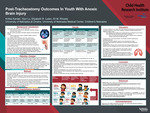
Anoxic brain injury (ABI) is a non-traumatic injury; may result from cardiac arrest, suffocation, drowning, choking, and other acute causes. ABI often results in persistent neurologic changes and developmental abilities. These include vision, speech, swallow, walking, and other areas of daily living. The severity of injury is variable, and in the most severely affected families and medical providers weigh life-prolonging interventions such as tracheostomy, despite the potential for persistent neurologic impairment. These decisions are difficult for parents and providers alike, and long-term outcomes are limited when compared to outcomes in children with premature lung disease or traumatic brain injury. Younger children and infants have higher associated mortality, but more potential for some recovery which adds uncertainty in this age group. This lack of clear data makes decision making challenging as the potential outcomes are inconsistent. Our retrospective study attempted to evaluate the long-term outcomes of affected children.
Rights
The author holds the copyright to this work and any reuse or permissions must be obtained from the author directly.
Keywords
ABI, tracheostomy, decannulation, liberation from ventilatory support, long-term developmental outcomes
Recommended Citation
Kandel, Kritika; Lyden, Elizabeth R.; Lu, Yijun; and Rhoads, Eli, "Post-Tracheostomy Outcomes In Youth With Anoxic Brain Injury" (2026). Posters: 2026 Summer Undergraduate Research Program. 1.
https://digitalcommons.unmc.edu/surp2026/1