

-
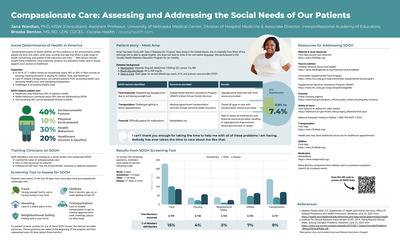
Compassionate Care: Assessing and Addressing the Social Needs of Our Patients
Jana L. Wardian PhD and Brooke Benton
This poster will show the impact of social determinants of health (SDOH) and psychosocial issues on diabetes care, as well as the effect of intentional assessment of SDOH in a telehealth care provider. Additional resources will be shared for addressing SDOH in patients with diabetes.
-
Introducing a Patient with Diabetes Experiencing the Social Determinants of Health to Students through Cinematic Virtual Reality
Jana L. Wardian PhD
Background: Cinematic virtual reality (cine-VR) is an innovative educational technique allowing users to immerse themselves in three-dimensional sensory environments. Cine-VR gives access to life-like medical encounters without risk or harm to the patient and offers insight into the lived experience of patients. Storytelling is a powerful tool to help health professions students to immerse themselves in another’s experience. We utilized a diabetes cine-VR training to highlight social determinants of health and impact on patient engagement.
The purpose of this study was to compare the effectiveness of web-based diabetes cine-VR training to improve diabetes attitudes and empathy among health professional students.
Methods: Our institution utilized the cine-VR web-based training for several healthcare profession student programs. We conducted paired t-tests to assess changes in diabetes attitudes and empathy at baseline and after the training. All analyses used SPSS version 26.0 (SPSS Inc.). Statistical significance was defined as P<0.05.
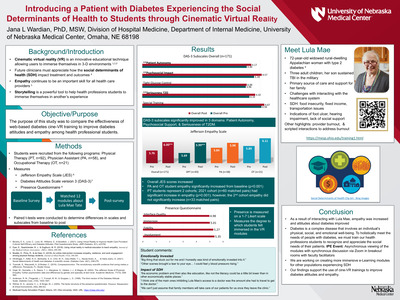
Results: We had a total of 127 students participate including Doctor of Physical Therapy students (60), Pharmacy students (10), and Physician Assistant students (57). Following viewing the 12 modules, we observed improvements in four of the diabetes attitude subscales: “Seriousness of type 2 diabetes” (P<0.001); “Value of tight glucose control” (P=0.01); “Psychosocial impact of diabetes” (P<0.001); and “Attitude toward patient autonomy” (P<0.001). In addition, we observed significant improvements in empathy (P<0.001).
Conclusions: Diabetes is a complex disease that involves an individual’s physical, social, and emotional well-being. To holistically meet the needs of people with diabetes, we must train our health professions students to recognize and appreciate the social needs of their patients. Our findings support the use of cine-VR trainings to improve diabetes attitudes and empathy.
Source of Funding for this Research: Osteopathic Heritage Foundation
-
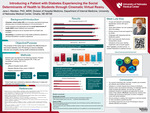
Introducing a Patient with Diabetes Experiencing the Social Determinants of Health to Students through Cinematic Virtual Reality
Jana L. Wardian PhD
Background: Cinematic virtual reality (cine-VR) is an innovative educational technique allowing users to immerse themselves in three-dimensional sensory environments. Cine-VR gives access to life-like medical encounters without risk or harm to the patient and offers insight into the lived experience of patients. Storytelling is a powerful tool to help health professions students to immerse themselves in another’s experience. We utilized a diabetes cine-VR training to highlight social determinants of health and impact on patient engagement.
The purpose of this study was to compare the effectiveness of web-based diabetes cine-VR training to improve diabetes attitudes and empathy among health professional students.
Methods: Our institution utilized the cine-VR web-based training for several healthcare profession student programs. We conducted paired t-tests to assess changes in diabetes attitudes and empathy at baseline and after the training. All analyses used SPSS version 26.0 (SPSS Inc.). Statistical significance was defined as P<0.05.
Results: We had a total of 127 students participate including Doctor of Physical Therapy students (60), Pharmacy students (10), and Physician Assistant students (57). Following viewing the 12 modules, we observed improvements in four of the diabetes attitude subscales: “Seriousness of type 2 diabetes” (P<0.001); “Value of tight glucose control” (P=0.01); “Psychosocial impact of diabetes” (P<0.001); and “Attitude toward patient autonomy” (P<0.001). In addition, we observed significant improvements in empathy (P<0.001).
Conclusions: Diabetes is a complex disease that involves an individual’s physical, social, and emotional well-being. To holistically meet the needs of people with diabetes, we must train our health professions students to recognize and appreciate the social needs of their patients. Our findings support the use of cine-VR trainings to improve diabetes attitudes and empathy.
Source of Funding for this Research: Osteopathic Heritage Foundation
Printing is not supported at the primary Gallery Thumbnail page. Please first navigate to a specific Image before printing.