

Files
Download Full Text (2.9 MB)
Conference
Nebraska Neurological Society
Document Type
Poster
Publication Date
11-4-2023
Abstract or Description
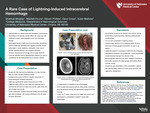
Objective: Lightning strike is a natural event with devastating consequences. Depending on the intensity, harmful effects can range from mild erythema to severe cardiorespiratory arrest and multi-organ damage. Neurological injuries include loss of consciousness, paresthesia, transient weakness, short/long term cognitive sequelae, visual hallucinations, cluster headache, myelopathy, motor neuron disease, cerebral infarction, and movement disorders. However, intracerebral hemorrhage (ICH) is rarely observed. Here we describe a presentation of ICH secondary to a lightning strike. Background: 45-year-old male was found by bystanders on a rainy morning fallen by a bike trail with a shattered helmet. Intubated at the scene for GCS of 7. Electrocardiogram revealed bradycardia, vitals significant for systolic blood pressure in 200mmHg. A lightning strike to the top of the head was suspected due to scorched hair and burns to scalp (entry wound), upper arms, and shoulders (exit wound). Further examination revealed periorbital swelling and hematoma, right sided hemiplegia, with withdrawal in the left upper and lower extremities. CT/MRI showcased a large left basal ganglia hemorrhage, scattered subarachnoid hemorrhage and stage I diffuse axonal injury. CTA Head/Neck was unremarkable. EEGs revealed moderate to severe encephalopathy with no ictal activity. Follow up CTs continued to be stable, and the patient was discharged to a rehabilitation hospital 5 weeks after presentation. Conclusion: Neurological injuries from lightning strikes are second only to cardiovascular injuries. Lightning can rarely cause basal ganglia ICH. Exact etiology for predilection to basal ganglia ICH remains unknown with few hypotheses. These patients will require aggressive management and can have good outcomes.
Recommended Citation
Mirajkar, Shalmali; Floura, Mitchell; Phillips, Steven; Gress, Daryl; and Mathew, Subin, "A Rare Case of Lightning-Induced Intracerebral Hemorrhage" (2023). Posters and Presentations: College of Medicine Students. 10.
https://digitalcommons.unmc.edu/com_students_pres/10