

Files
Download Full Text (3.1 MB)
Conference
Nebraska Infectious Diseases Society
Document Type
Poster
Publication Date
8-23-2024
Abstract or Description
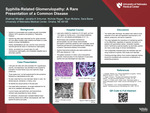
Background: Syphilis is a preventable and curable sexually transmitted infection (STI) caused by the bacterium Treponema Pallidum. Syphilis has often been described as the “great mimicker” as it can affect multiple organ systems and leads to a wide variety of clinical manifestations. Kidney manifestations are rare, and the most commonly reported glomerular lesion is membranous nephropathy. Herein, we present an unusual case of a rash, membranous nephropathy and cholestatic hepatitis due to secondary syphilis. Case: A 68-year-old male with well-controlled HIV, hypertension, anemia, and depression was admitted to the hospital for evaluation of acute kidney injury and nephrotic-range proteinuria. Three weeks prior, he had experienced flu-like symptoms followed by a generalized pruritic rash. He also noted that his urine had been darker in color. He denied dysuria, hematuria, or foamy urine. He denied any sexual activity in the last year. One week before admission, he sought treatment for his rash at an outpatient dermatology clinic. A punch biopsy was performed, and triamcinolone ointment was prescribed but never utilized. On admission, physical exam revealed bilateral lower extremity edema and a diffuse maculopapular rash that spared the palms and soles. Labs were notable for creatinine of 2.34 mg/dL (up from 1.36 mg/dL six months prior), urine protein/creatinine ratio of 9.2, and alkaline phosphatase of 417 U/L. Renal biopsy exhibited membranous glomerulopathy and skin biopsy demonstrated psoriasiform acanthotic epidermis with moderately dense superficial perivascular lymphoplasmacytic infiltrate and a positive Treponema antibody immunostain. Syphilis treponemal antibody was newly positive and RPR was reactive at 1:128. The patient received 2.4 million units of benzathine penicillin intramuscularly for the treatment of secondary syphilis and was discharged two days later. Two weeks after discharge, the patient was noted to have resolution of his rash and significant improvement in his edema, proteinuria, and serum creatinine. Discussion: Identification and appropriate treatment of secondary syphilis resulted in resolution of this patient’s rash and acute kidney injury. Conclusion: This case highlights the importance of maintaining syphilis on the differential, regardless of reported risk factors, in patients with generalized rashes, cholestatic hepatitis, and/or membranous glomerulopathy as secondary syphilis can have a wide range of clinical manifestations. Checking serology before more invasive diagnostic testing should be considered with uncommon combinations of presenting symptoms.
Recommended Citation
Mirajkar, Shalmali; Srikumar, Jainaha K.; Regan, Nichole; Mullane, Ryan P.; and Bares, Sara, "Syphilis-Related Glomerulopathy: A Rare Presentation of a Common Disease" (2024). Posters and Presentations: College of Medicine Students. 5.
https://digitalcommons.unmc.edu/com_students_pres/5