

Files
Download Full Text (1.7 MB)
Conference
Nebraska Infectious Diseases Society
Document Type
Poster
Publication Date
8-25-2023
Abstract or Description
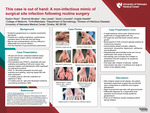
Background: Pyoderma gangrenosum is a reactive, non-infectious neutrophilic dermatosis that classically presents as a rapidly progressive, erythematous, ulcerative lesion of the skin and soft tissue, sometimes accompanied by necrosis and purulence. It has been reported following routine surgery, and the shared features with skin and soft tissue infection can lead to treatment with antibiotics and further surgical interventions before diagnosis. Case: A 49-year-old woman presented 6 days after a bilateral carpal tunnel release with 3 days of increased pain, erythema, and swelling of the left surgical site with redness tracking up the arm. Empiric antibiotics were started for presumed surgical site infection, and she underwent irrigation and debridement (I&D) of the left carpal tunnel with extensive purulence visualized intraoperatively. She was treated with cefepime and vancomycin for 2 days then transitioned to doxycycline as wound bacterial cultures were without growth. On post-op day 4, there was increased swelling and erythema of the left surgical site prompting repeat I&D, drain placement and initiation of IV ceftriaxone and daptomycin via peripherally inserted central catheter. Three additional I&Ds of the left wrist were performed over 3 weeks for persistent symptoms. Her right wrist incision developed purulent drainage and the patient underwent 2 right sided I&Ds. A single bacterial culture grew Staphylococcus epidermidis in thioglycolate broth only, while multiple cultures for fungi and acid-fast bacilli were negative. Histopathology demonstrated acute and chronic inflammation with areas of necrosis. Broad range PCR of aspirate from her second left wrist I&D demonstrated Comamonas aquatica prompting exchange of ceftriaxone for levofloxacin and continuation of empiric daptomycin. Six weeks after her initial surgery, the patient was referred to dermatology for persistent wounds. Pyoderma gangrenosum was suspected and a trial of prednisone was initiated. One week later, there was marked improvement with decreased erythema and increased range of motion of both wrists. Antibiotics were discontinued and steroids tapered as her condition improved. Discussion: After bilateral carpal tunnel release, this patient developed suppurative surgical site wounds that were unresponsive to antibiotics and surgical debridement. It is unlikely that either C. aquatica or S. epidermidis contributed to this patient’s condition due to persistence of symptoms with appropriate antibiotics. Rapid improvement was seen with glucocorticoids, consistent with pyoderma gangrenosum. Conclusion: The differential diagnosis for a suppurative post-operative wound should include pyoderma gangrenosum. Failure to improve on antimicrobial therapy with nondiagnostic microbiologic and histopathologic studies should prompt referral to dermatology for evaluation of non-infectious etiologies.
Recommended Citation
Reed, Keaton; Mirajkar, Shalmali; Lesiak, Alex; Lonowski, Sarah L.; and Hewlett, Angela L., "This Case is Out of Hand: A Non-Infectious Mimic of Surgical Site Infection Following Routine Surgery" (2023). Posters and Presentations: College of Medicine Students. 6.
https://digitalcommons.unmc.edu/com_students_pres/6