

Files
Download Full Text (3.5 MB)
Conference
Omaha Area Trauma Symposium
Document Type
Poster
Publication Date
6-14-2024
Abstract or Description
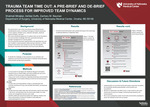
Background: The trauma team is one of the most diverse interprofessional and multidisciplinary teams found in the hospital, consisting of emergency medicine physicians, trauma surgeons, bedside nurses, respiratory therapists, advanced practice providers, and more. With many individuals taking care of an individual patient, there can be frustrations and communication challenges that arise, particularly during these emergency and stressful situations. Time-out protocols implemented in the operating room have resulted in improved patient safety and team dynamics. A similar protocol in the trauma bay could carry over similar benefits, allowing for improved communication and trauma team efficiency. The purpose of this study is to identify the challenges in team dynamics at our institution and implement a pre-brief and de-brief system to facilitate interprofessional communication and better teamwork during trauma activations. Methods: A survey based on the Agency for Healthcare Research and Quality Hospital Survey on Patient Safety and Culture (SOPS) was sent out to members of the trauma team at Nebraska Medicine. The survey results highlighted a need for closed-loop communication for questions and concerns, increased transparency, and better follow-up after trauma activations commenced. To address this gap and promote continued improvement of team dynamics, a timeout for a pre-brief and de-brief process were created, supported with two posters outlining the process. These posters were physically hung in the trauma bays. The pre-brief and de-brief processes were created using literature highlighting the necessary elements in the processes. The pre-brief includes roles and responsibilities, things to anticipate given the traumatic mechanism of injury and encoded information, and potential dispositions. The debrief includes discussion about what went well and what could be done better in the future, education from the trauma team leader as to why certain care management decisions were made. It also identifies additional equipment/supplies that might be needed in the future and provides an avenue for people to seek additional emotional/supportive services. Results: Currently the pre-brief and debrief process has been accepted and welcomed with great success. Anecdotally, it has improved team dynamics and communication and provided education to run future trauma activations more efficiently. All team members have loved the education that has come from this process as well. The pilot study is currently ongoing. Conclusion: Implementation of a pre-brief and de-brief system using time-out posters allows for greater communication within the team and has already resulted in improved resuscitations during recent trauma activations. Future directions of this research study include readministering the SOPS survey in a few months to quantify the changes in perceived team dynamics and communication.
Recommended Citation
Mirajkar, Shalmali; Duffy, Ashlee Mills; and Bauman, Zachary, "Trauma Team Time Out: A Pre-Brief and De-Brief Process for Improved Team Dynamics" (2024). Posters and Presentations: College of Medicine Students. 7.
https://digitalcommons.unmc.edu/com_students_pres/7