

Files
Download Full Text (691 KB)
Conference
International Online Conference of Health Workforce Education
Document Type
Poster
Publication Date
1-7-2026
Abstract
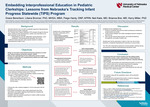
Background: NICU graduates experience disproportionate developmental and health challenges. Their families face barriers to equitable care including access to coordinated follow-up services. Traditional medical education rarely exposes students to authentic interprofessional models of care that address these inequities. The Tracking Infant Progress Statewide (TIPS) program provides developmental, social, and medical follow-up for NICU graduates across Nebraska, bringing together physicians, nurse practitioners, child developmental specialists, and nurses in a single family-centered visit. Embedding third-year medical students into this setting models collaborative practice, builds understanding of interprofessional competencies, and fosters awareness of systemic inequities affecting NICU families. This innovative curricular approach differs from the traditional siloed medical clerkship education and addresses gaps in interprofessional clinical practice exposure.
Objectives: To design an innovative interprofessional learning experience for third-year medical students during their pediatric rotation, enhancing understanding of how collaborative practice enables providers to efficiently and comprehensively address the health needs of patients and families.
Methods: A total of 302 third-year medical students at the University of Nebraska Medical Center attended a half-day session at the TIPS clinic within the Munroe Meyer Institute. Prior to the sessions, students read Building a System of Child Find Through a 3-Tiered Model of Follow-up. They observed the visits via live feed to minimize clinical disruptions. Following the visits, students engaged in a thirty-minute discussion with the providers, reflecting on the visits and asking questions. Each student completed an open-ended question about their observations and insights regarding interprofessional competencies allowing for qualitative analysis. Qualitative data was analyzed using Braun & Clarke’s (2006) six-phase thematic analysis framework.
Results: Qualitative themes highlighted that 1) students consistently observed how distinct professional contributions complemented one-another, 2) family-centered dialogue and unified messaging reassured caregivers and built trust, 3) team synergy reduced family burdens, and enhanced efficiency, thoroughness, and quality of patient care. The results show that modeling collaborative practice serves as an effective educational model for enriching trainee understanding of interprofessional competencies and professional identity development, underscoring the value of integrating interprofessional models into medical education.
Discussion: The TIPS clinic observational experience enriched pediatric clerkship training and served as an effective interprofessional educational model. Students not only observed collaborative behaviors that enhanced family-centered outcomes but also reflected on how these experiences shaped their emerging professional identities. This innovation demonstrates that interprofessional practice can serve as both a clinical model and an educational imperative for preparing physicians to deliver collaborative, family-centered care.
Rights
The author holds the copyright to this work and any reuse or permissions must be obtained from the author directly.
Disciplines
Interprofessional Education | Medical Education | Pediatrics
Recommended Citation
Berentson, Grace E.; Bronner, Liliana; Hardy, Paige; Kalsi, Neil; Brei, Brianna; and Miller, Kerry, "Embedding Interprofessional Education in Pediatric Clerkships: Lessons from Nebraska’s Tracking Infant Progress Statewide (TIPS) Program" (2026). Posters and Presentations: Munroe-Meyer Institute. 3.
https://digitalcommons.unmc.edu/mmi_pres/3