

Files
Download Full Text (333 KB)
Presentation date
8-22-2025
College
College of Medicine
Abstract
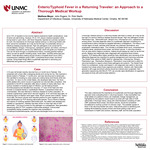
Up to 70% of travelers to low-income regions experience health complications, most of which are self-limiting. However, 8% to 15% require medical evaluation either during travel or upon return, with fever frequently reported as a primary symptom.1 As such, the importance of a thorough medical workup in a returning traveler with fever cannot be overstated, as it may be the first sign of a potentially serious or infectious disease acquired abroad. High risk pathogens to be concerned for include Malaria, Dengue, Chikungunya, Leptospiral, typhoid, and others, and thus it is incredibly important to narrow your differential, which will guide your treatment. This can be done through a comprehensive history, including general medical history as well as specific travelling areas, foods eaten, activities performed and others. Initial laboratory testing should include a complete blood count (CBC), comprehensive metabolic panel (CMP), a peripheral blood smear, and blood cultures. Doing these things offers a systematic approach to narrowing your differential and guides your treatment.
Keywords
fever in a returning traveler, fever of unknown origin
Recommended Citation
Meyer, Matthew; Rogers, John; and Starlin, Rick, "Enteric/Typhoid Fever in a Returning Traveler: an Approach to a Thorough Medical Workup" (2025). Medical Student Research Showcase. 3.
https://digitalcommons.unmc.edu/com_msrs/3