
-
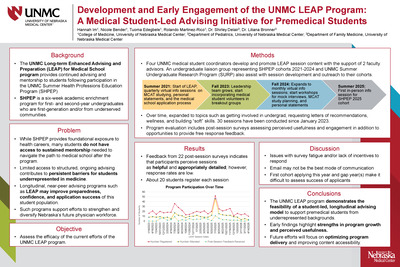
Development and Early Engagement of the UNMC LEAP Program: A Medical Student-Led Advising Initiative for Premedical Students
Hannah Im, Nicole Bender, Tuoma Edegbele, Rolando Martinez-Rico, Shirley F. Delair, and Liliana Bronner
Background: The goal of UNMC’s Long-term Enhanced Advising and Preparation (LEAP) for Medical School program is to provide sustained advising and mentorship for students who participate in the UNMC Summer Health Professions Education Program (SHPEP). This six-week academic enrichment program for first- and second-year, first-generation and/or underserved undergraduate students provides foundational exposure to health careers. Many participants, however, lack the sustained mentorship and guidance needed to navigate the medical school application process after completing SHPEP.
Methods: Since 2021, LEAP has evolved into a team of medical student coordinators, two faculty mentors, and undergraduate liaisons from past SHPEP cohorts. Programming has expanded from quarterly to monthly virtual sessions covering MCAT preparation, application strategies, professional development, and wellness. Sessions include a large-group didactic and medical student led small-group portion. Expanded interactive workshops for select topics (e.g., interview practice, personal statement development) are also offered. Post-session surveys assess perceived usefulness and engagement, along with review of participation trends and feedback. Given the longitudinal nature of the medical school application process and frequent gap years, evaluation has focused on early indicators of engagement rather than matriculation outcomes.
Results: LEAP delivers 10 sessions each school year between July and April. About 20 students consistently register for sessions each month, and all respondents reported sessions as helpful. Response rates to post-session surveys, however, remain low. Additionally, recurring requests for previously covered topics suggest opportunities to improve content accessibility beyond currently available recorded sessions.
Conclusion: The UNMC LEAP program demonstrates the feasibility of a student-led, low-cost, longitudinal advising model to support premedical students from underrepresented backgrounds. Early findings highlight strengths in program growth and perceived usefulness as well as opportunities to enhance engagement and access to resources. Ongoing efforts will focus on optimizing program delivery and evaluating longer-term outcomes, including medical school matriculation success.
-
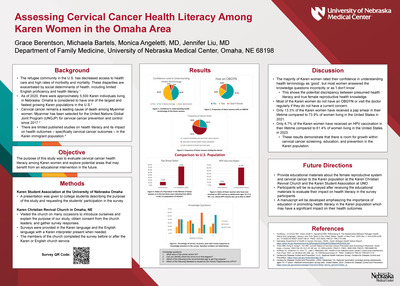
Assessing Cervical Cancer Health Literacy Among Karen Women in the Omaha Area
Grace E. Berentson, Michaela Bartels, Jennifer Liu, and Monica Angeletti
Cervical cancer is one of the leading causes of death among Karen women, a predominant ethnic group in Myanmar. One of the largest and fastest growing Karen populations in the United States is located in Omaha, Nebraska. The objective of our study is to evaluate cervical cancer health literacy among Karen women and explore potential knowledge gaps that could be addressed with an educational intervention in the future. A survey was given to Karen women at the Karen Student Association at the University of Nebraska Omaha (UNO) and members of the Karen Christian Revival Church in Omaha, NE. The survey inquired about personal and medical history and evaluated health knowledge pertaining to the female reproductive system and cervical cancer. The results were significant in that a majority of Karen women rated their confidence in understanding health terminology as ‘good’, but most women answered the knowledge questions incorrectly or as 'I don't know.’ Only 13.3% and 6.7% of Karen women have received a pap smear or HPV vaccine, respectively, in their lifetime which is much lower than the average rates for women living in the United States. These results demonstrate the potential discrepancy between presumed health literacy and true female reproductive health knowledge, and the room for growth available within cervical cancer screening in the Karen population. The next steps in our research project will be to provide educational materials about the female reproductive system, cervical cancer, and cervical cancer screening to the Karen population at the Karen Student Association at UNO and Karen Christian Revival Church. Afterwards, we will then re-survey the participants to evaluate the effectiveness of our educational intervention and its impact on health literacy, with an overall goal of improving health outcomes in the Karen population.
-
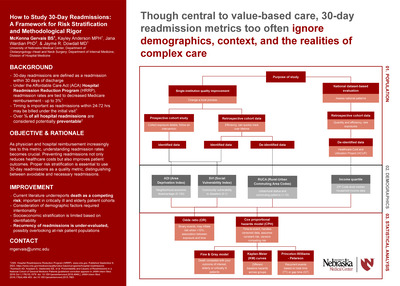
How to Study 30-Day Readmissions: A Framework for Risk Stratification and Methodological Rigor
McKenna Gervais, Kayley Anderson, Jana Wardian, and Jayme Dowdall
Background: The 2010 Affordable Care Act (ACA) catalyzed a shift toward value-based care. This introduced reimbursement penalties tied to hospital performance metrics, such as the Hospital Readmission Reduction Program (HRRP) which deducts reimbursement for institutions with excessive 30-day readmission rates. Although more than 25% of hospital readmissions are considered potentially avoidable, the methods of evaluation are often inconsistent, and overlook medically complex patients and those who experience recurrent readmissions.
Objective: To identify methodologies used in current 30-day readmission studies and to propose improved methodological framework for population inclusion, demographic considerations, and statistical analysis to allow for proper risk stratification.
Methods: A scoping literature review across pulmonology, otolaryngology, nephrology, cardiology, and internal medicine to identify and map how 30-day readmissions are studied in various fields. Key characteristics such as determination of inclusion criteria, consideration of recurrent readmissions and competing risk of death, and presentation of patient demographics and socioeconomic disparities were examined and reported. Strengths of various statistical models such as Cox proportional hazards, Prentice-Williams-Peterson (PWP-TT), and Fine & Gray subdistribution hazard modeling were defined.
Results: Many studies fail to account for critically ill patient populations, multiple encounters, and demographic variability - vital metrics in quality improvement. Proper risk stratification must be done on readmissions in order to properly use 30-day readmits as a quality metric, distinguishing between avoidable readmissions and those that necessitate additional care.
Conclusion: This review presents a framework for designing and evaluating 30-day readmission studies. By outlining use cases for population inclusion criteria, demographic reporting, and statistical analysis methods, it supports improved study methodology through intentional design. This approach aims to enhance the validity of 30-day readmission studies as a value-based evaluation metric.
-
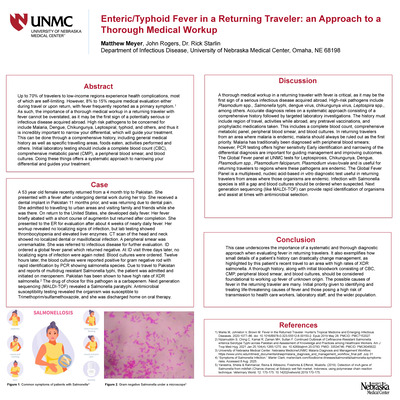
Enteric/Typhoid Fever in a Returning Traveler: an Approach to a Thorough Medical Workup
Matthew Meyer, John Rogers, and Rick Starlin
Up to 70% of travelers to low-income regions experience health complications, most of which are self-limiting. However, 8% to 15% require medical evaluation either during travel or upon return, with fever frequently reported as a primary symptom.1 As such, the importance of a thorough medical workup in a returning traveler with fever cannot be overstated, as it may be the first sign of a potentially serious or infectious disease acquired abroad. High risk pathogens to be concerned for include Malaria, Dengue, Chikungunya, Leptospiral, typhoid, and others, and thus it is incredibly important to narrow your differential, which will guide your treatment. This can be done through a comprehensive history, including general medical history as well as specific travelling areas, foods eaten, activities performed and others. Initial laboratory testing should include a complete blood count (CBC), comprehensive metabolic panel (CMP), a peripheral blood smear, and blood cultures. Doing these things offers a systematic approach to narrowing your differential and guides your treatment.
-
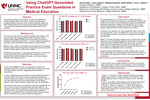
Using ChatGPT-Generated Practice Exam Questions in Medical Education
Jack Paradis, Currey Zalman, Makayla Schissel, Geoffrey Talmon, and Kari L. Nelson
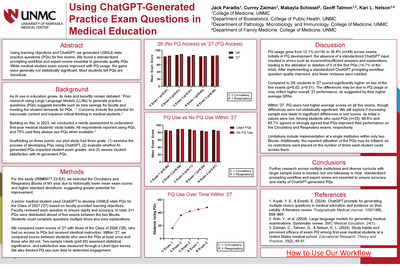
Background: As artificial intelligence expands in medical education, large language models like ChatGPT have shown potential for efficiently generating practice questions (PQs). A 2023 needs assessment at our institution found that all first-year medical students used PQs, with 75% reporting they always use them when available. To support active learning and exam preparation, we utilized ChatGPT to generate PQs for the historically challenging Circulatory and Respiratory Blocks of the M1 year. Our pilot study aimed to (1) examine the process of developing PQs using ChatGPT, (2) evaluate the impact of ChatGPT-generated PQs on exam performance, and (3) assess student satisfaction.
Methods: A senior medical student used ChatGPT to develop USMLE-style PQs for the Class of 2027 ('27) based on faculty-provided learning objectives. Faculty reviewed each question to ensure clarity and accuracy. In total, 211 PQs were distributed ahead of five exams between the two Blocks. Students could complete questions multiple times and view explanations. We compared exam scores of '27 with those of the Class of 2026 ('26), who had no access to PQs but received identical instruction. Within '27, we compared scores between students who used the PQs at least once and those who did not. Two-sample t-tests (p≤0.05) assessed statistical significance, and satisfaction was measured through a Likert-type survey.
Results: PQ usage grew from 12.1% (n=16) to 36.4% (n=48) across exams. After standardizing ChatGPT prompts, question quality improved, and fewer revisions were needed. Compared to '26, students in '27 scored significantly higher on two of the five exams (p=0.02, p< 0.01). Within '27, PQ users had higher average scores on all five exams, though differences were not statistically significant. Among students who used PQs (n=35), 68.6% and 65.7% agreed or strongly agreed that PQs improved their performance on the Circulatory and Respiratory exams, respectively.
Conclusions: Further research across multiple institutions and diverse curricula with larger sample sizes is needed, but one takeaway is clear: standardized prompting workflow and expert review are essential to ensure accuracy and clarity of ChatGPT-generated PQs.
-
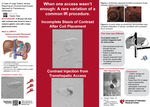
A Case of Large Gastric Varices Requiring an Unusual Dual-Access Approach to Transvenous Obliteration
Trenten Theis and Lei Yu
Background:
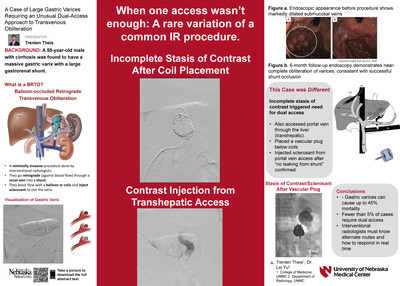
Balloon-occluded retrograde transvenous obliteration (BRTO) is an image-guided procedure used to treat high-risk gastric varices by occluding portosystemic shunts and injecting sclerosant to induce thrombosis. Gastric varices occur in approximately 20% of patients with portal hypertension, with bleeding carrying mortality rates up to 45%. In most cases, retrograde venous access through the renal vein and shunt is sufficient for variceal obliteration. However, unusual venous anatomy or flow dynamics can complicate this process, requiring advanced techniques.
Case:
A 55-year-old male with cirrhosis was found to have a massive gastric varix with a large gastrorenal shunt. Standard retrograde access was achieved entering from the right femoral vein into the left renal vein. A dense coil pack was placed at the shunt opening toward the renal vein, but contrast injection failed to demonstrate adequate stasis within the varix. Due to persistent flow, an anterograde transhepatic portal venous approach was added to access the variceal complex directly. Once adequately visualized, a vascular plug was placed from the portal side into the shunt to prevent flow. Only after plug deployment did contrast stasis occur within the varix, confirming successful flow isolation. Sclerosant was then injected to complete the procedure. Adequate thrombosis was confirmed by demonstrating absence of contrast flow from the renal side as well. The patient tolerated the procedure well, with no immediate complications, and follow-up imaging confirmed variceal thrombosis.
Conclusion:
This case demonstrates a rare hybrid BRTO technique requiring both retrograde and anterograde access, reported in fewer than 5% of cases. Portal plug placement was essential to achieve flow disruption and sclerosant retention. While BRTO is typically performed through a single venous access, anatomical variations or inadequate contrast stasis may necessitate more complex hybrid approaches. This case underscores the importance of procedural adaptability and precise intraoperative imaging in interventional radiology.
-
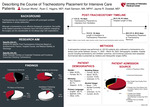
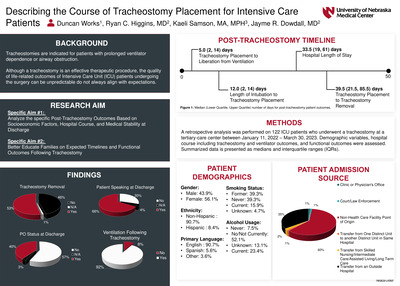
Describing the Course of Tracheostomy Placement for Intensive Care Patients
Duncan Works, Ryan Higgins, Kaeli Samson, and Jayme Dowdall
Printing is not supported at the primary Gallery Thumbnail page. Please first navigate to a specific Image before printing.