

Files
Download Full Text (799 KB)
Download Visualization of Gastric Varix.mp4 (1.1 MB)
Download Incomplete Stasis of Contrast.mp4 (1.1 MB)
Download injection from portal vein access showed large varices and contrast leaking through large coil pack.mp4 (1.7 MB)
Download embolization agent mixed with contrast remains in varices after placing additional vascular plug.png (230 KB)
Presentation date
8-2025
College
College of Medicine
Abstract
Background:
Balloon-occluded retrograde transvenous obliteration (BRTO) is an image-guided procedure used to treat high-risk gastric varices by occluding portosystemic shunts and injecting sclerosant to induce thrombosis. Gastric varices occur in approximately 20% of patients with portal hypertension, with bleeding carrying mortality rates up to 45%. In most cases, retrograde venous access through the renal vein and shunt is sufficient for variceal obliteration. However, unusual venous anatomy or flow dynamics can complicate this process, requiring advanced techniques.
Case:
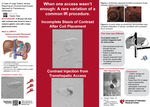
A 55-year-old male with cirrhosis was found to have a massive gastric varix with a large gastrorenal shunt. Standard retrograde access was achieved entering from the right femoral vein into the left renal vein. A dense coil pack was placed at the shunt opening toward the renal vein, but contrast injection failed to demonstrate adequate stasis within the varix. Due to persistent flow, an anterograde transhepatic portal venous approach was added to access the variceal complex directly. Once adequately visualized, a vascular plug was placed from the portal side into the shunt to prevent flow. Only after plug deployment did contrast stasis occur within the varix, confirming successful flow isolation. Sclerosant was then injected to complete the procedure. Adequate thrombosis was confirmed by demonstrating absence of contrast flow from the renal side as well. The patient tolerated the procedure well, with no immediate complications, and follow-up imaging confirmed variceal thrombosis.
Conclusion:
This case demonstrates a rare hybrid BRTO technique requiring both retrograde and anterograde access, reported in fewer than 5% of cases. Portal plug placement was essential to achieve flow disruption and sclerosant retention. While BRTO is typically performed through a single venous access, anatomical variations or inadequate contrast stasis may necessitate more complex hybrid approaches. This case underscores the importance of procedural adaptability and precise intraoperative imaging in interventional radiology.
Keywords
BRTO, Gastric Varix, Cirrhosis, Portal Hypertension
Recommended Citation
Theis, Trenten and Yu, Lei, "A Case of Large Gastric Varices Requiring an Unusual Dual-Access Approach to Transvenous Obliteration" (2025). Medical Student Research Showcase. 4.
https://digitalcommons.unmc.edu/com_msrs/4