

Files
Download Full Text (1.9 MB)
Presentation date
Fall 8-7-2025
College, Institute, or Department
Pharmaceutical Sciences
Faculty Mentor
Don Ronning, Ph.D
Research Mentor
Don Ronning, Ph.D
Abstract
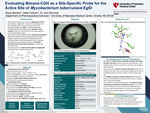
Mycobacterium tuberculosis relies on ergothioneine (EGT), a low-molecular-weight thiol, to maintain redox balance and resist oxidative stress and anti-tubercular drugs. EGT biosynthesis begins with EgtD, an AdoMet-dependent methyltransferase that trimethylates L-histidine to form hercynine, making EgtD a promising therapeutic target. This study evaluated the binding potential of a synthetic bimane-CGH probe designed to mimic substrate interactions and occupy the EgtD active site, with a fluorescent bimane tag for detection in structural assays. EgtD was expressed in E. coli, purified via cobalt affinity and size-exclusion chromatography, and co-crystallized with bimane-CGH. X-ray diffraction data were collected to 2.0 Å resolution, and the structure was solved and refined. Results revealed partial binding of bimane-CGH within the EgtD active site, with well-defined density for the histidine and glycine residues but uncertainty in the bimane position, possibly due to dynamic movement around the cysteine sulfur. These findings suggest the need for modified probe designs to achieve stable binding and inform future structure-based inhibitor development against M. tuberculosis EgtD.
Keywords
X-ray Diffraction, M. Tuberculosis, Crystallography, EgtD
Recommended Citation
Benitez, Bryan; Erikson, Helen; and Ronning, Don, "Evaluating Bimane-CGH as a Site-Specific Probe for the Active Site of Mycobacterium tuberculosis EgtD" (2025). Posters: 2025 Summer Undergraduate Research Program. 5.
https://digitalcommons.unmc.edu/surp2025/5