


-
Evaluating Bimane-CGH as a Site-Specific Probe for the Active Site of Mycobacterium tuberculosis EgtD
Bryan Benitez, Helen Erikson, and Don Ronning
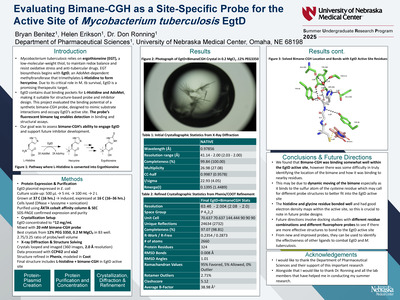
Mycobacterium tuberculosis relies on ergothioneine (EGT), a low-molecular-weight thiol, to maintain redox balance and resist oxidative stress and anti-tubercular drugs. EGT biosynthesis begins with EgtD, an AdoMet-dependent methyltransferase that trimethylates L-histidine to form hercynine, making EgtD a promising therapeutic target. This study evaluated the binding potential of a synthetic bimane-CGH probe designed to mimic substrate interactions and occupy the EgtD active site, with a fluorescent bimane tag for detection in structural assays. EgtD was expressed in E. coli, purified via cobalt affinity and size-exclusion chromatography, and co-crystallized with bimane-CGH. X-ray diffraction data were collected to 2.0 Å resolution, and the structure was solved and refined. Results revealed partial binding of bimane-CGH within the EgtD active site, with well-defined density for the histidine and glycine residues but uncertainty in the bimane position, possibly due to dynamic movement around the cysteine sulfur. These findings suggest the need for modified probe designs to achieve stable binding and inform future structure-based inhibitor development against M. tuberculosis EgtD.
-

Improving Occupational Health for Tribal Buffalo Workers
Elinor Bowen-Keyes and Mystera M. Samuelson
Occupational health and safety of Tribal buffalo workers is essential to many Tribal food sovereignty initiatives taking place within Tribal nations across the country, supporting the broader effort to bring the buffalo home. In response to requests from Intertribal Buffalo Council (ITBC) members, we developed occupational health cards identifying top zoonotic disease risks to improve patient–clinician communication. Each card links via QR code to a comprehensive clinician guidance booklet that includes etiologic agents, transmission routes, symptoms, occupation-specific screening questions, and reporting resources. Using a One Health approach, we mapped county-level data for ITBC buffalo herds, including elevation, ecosystem type, and seasonal climate averages, and compiled human and animal zoonotic disease data (2020–2025) by state. These were cross-referenced with emerging and existing agricultural diseases to identify the highest-risk threats and analyzed correlations between geography and disease occurrence in agricultural occupations. Findings and interventions were presented at the 2025 Buffalo Worker Safety and Herd Health Roundtable for community feedback, and finalization is ongoing.
-

ASDAT: Evaluating Autism Symptom Severity
Anne F. Coffey, Amanda Oliver, Laura Phipps, Patricia Zemantic, and Alice Shillingsburg
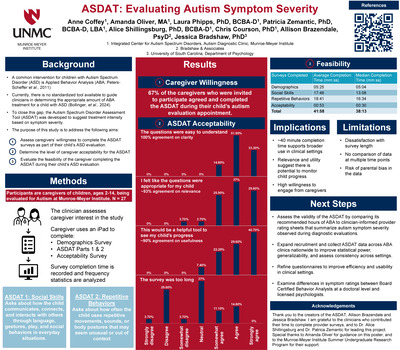
This study aims to develop and validate the Autism Spectrum Disorder Assessment Tool (ASDAT), a user-friendly, objective tool for assessing the severity of ASD symptoms and informing treatment planning. Currently, there are no tools that both evaluate ASD severity across DSM-5 criteria and guide treatment dosage recommendations. The ASDAT will address this gap by providing a standardized measure that aids diagnosticians and practitioners in determining appropriate care and treatment levels. Children aged 16 months to 14 years who are receiving diagnostic services at MMI’s Autism Diagnostic Clinic, along with their caregivers, will be recruited for this study. While the children are the primary recipients of the diagnostic services, their caregivers will participate by completing four surveys via REDCap about their child: one collecting demographic and medical information, one assessing the child’s communication and social interaction, one evaluating restricted and repetitive behaviors, and one providing feedback on the survey’s acceptability. Caregivers will complete these surveys only once, during their child's diagnostic appointment. Additionally, providers who are both part of the ADC clinic and the research team will complete two questionnaires: a demographics questionnaire about themselves and a survey about the child participant for whom they are providing diagnostic services. The ASDAT will be tested for diagnostic sensitivity and specificity, and its acceptability and feasibility will be evaluated through completion rates and time. This study will provide insights into the ASDAT’s ability to diagnose ASD and guide treatment decisions, with the goal of creating a standardized, objective tool for clinicians, diagnosticians, and managed care providers.
-
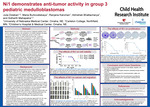
Ni1 Demonstrates Anti-Tumor Activity in Group 3 Pediatric Medulloblastomas
Julia Dziekan, Maria Burkovetskaya, Ranjana Kanchan, Abhishek Bhattacharya, and Sidharth Mahapatra
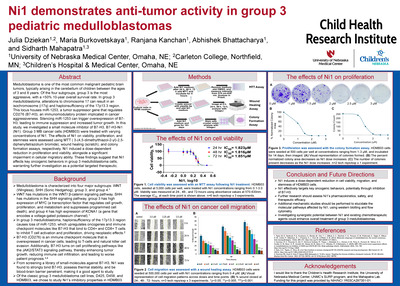
Medulloblastoma is one of the most common malignant pediatric brain tumors, typically arising in the cerebellum of children between the ages of 3 and 8 years. Of the four subgroups, group 3 is the most aggressive, with a < 50% 10-year overall survival rate. In group 3 medulloblastoma, alterations to chromosome 17 can result in an isochromosome (i17q) and haploinsufficiency of the 17p13.3 region. This locus houses miR-1253, a tumor suppressor gene that regulates CD276 (B7-H3), an immunomodulatory protein implicated in cancer aggressiveness. Silencing miR-1253 can trigger overexpression of B7-H3, leading to immune suppression and increased tumor growth. In this study, we investigated a small molecule inhibitor of B7-H3, B7-H3-Ni1 (Ni1). Group 3 MB cancer cells (HDMB03) were treated with varying concentrations of Ni1. The effects of Ni1 on viability, proliferation, and stemness were assessed using MTT ( 3-(4,5-dimethylthiazol-2-yl)-2,5-diphenyltetrazolium bromide), wound healing (scratch), and colony formation assays, respectively. Ni1 induced a dose-dependent reduction in proliferation and viability, alongside a significant impairment in cellular migratory ability. These findings suggest that Ni1 affects key oncogenic behaviors in group 3 medulloblastoma cells, warranting further investigation as a potential targeted therapeutic.
-
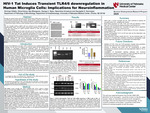
HIV-1 Tat Induces Transient TLR4/6 downregulation in Human Microglia Cells: Implications for Neuroinflammation
Shrimayi Gillella, Olivia Antony, Biju Bhargavan, George C. Njoku, Narendran Annadurai, and Georgette D. Kanmogne
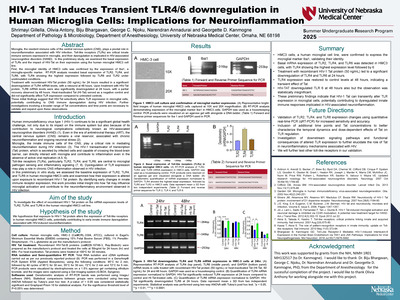
Microglia, the resident immune cells of the central nervous system (CNS), plays a pivotal role in neuroinflammation associated with HIV infection. Toll-like receptors (TLRs) are critical innate immune sensors expressed in microglia, and their dysregulation is implicated in HIV-associated neurocognitive disorders (HAND). In this preliminary study, we examined the basal expression of TLRs and the impact of HIV-Tat on their expression using the human microglial HMC3 cell line.
First, the microglial identity of HMC3 cells was confirmed by the expression of Iba1, a microglia-specific marker. RT-PCR analysis revealed basal expression of TLR2, TLR4, andTLR6, with TLR4 showing the highest expression followed by TLR6 and TLR2 under unstimulated conditions.
Treatment with recombinant HIV-Tat protein (50 ng/mL) for 24 hours resulted in a significant downregulation of TLR4 mRNA levels, with a rebound at 48 hours. Upon treatment with HIV-Tat protein, TLR6 mRNA levels were also significantly downregulated at 24 hours, with a partial recovery observed by 48 hours. Heat-inactivated Tat (HI-Tat) served as a negative control and did not significantly affect TLR expression compared to untreated controls.
These initial findings suggest that HIV-Tat selectively alters TLR expression in microglial cells, potentially contributing to CNS immune dysregulation during HIV infection. Further investigations involving a broader range of Tat concentrations and time points are necessary to validate and expand upon these observations.
-
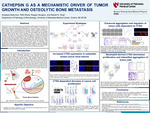
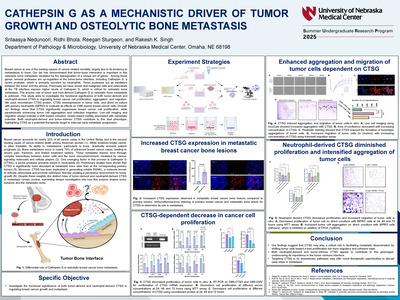
Cathepsin G as a Mechanistic Driver of Tumor Growth and Osteolytic Bone Metastasis
Srilaasya Nedunoori, Ridhi Bhola, Reegan Sturgeon, and Rakesh K. Singh
Breast cancer is one of the leading causes of cancer-related mortality, largely due to its tendency to metastasize to bone. Our lab has demonstrated that tumor-bone interaction is important in this osteolytic bone metastasis mediated by the dysregulation of a unique set of genes. Among these genes, several proteases are up-regulated at the tumor-bone interface, including Cathepsin G, a serine protease, which is primarily secreted by neutrophils. These proteases act as mediators between the tumor and the stroma. Previously, we have shown that malignant cells and osteoclasts at the TB interface express higher levels of Cathepsin G, which is critical for osteolytic bone metastasis. The precise role of tumor and host-derived Cathepsin G in osteolytic bone metastasis is unknown. This study aims to investigate the functional significance of both tumor-derived and neutrophil-derived CTSG in regulating breast cancer cell proliferation, aggregation, and migration. We used recombinant CTSG protein, CTSG overexpression in tumor cells, and direct co-culture with primary neutrophils (MPRO) to evaluate its effects on CI66 murine breast cancer cells. Overall, our findings show that CTSG significantly suppresses breast cancer cell proliferation, while paradoxically enhancing tumor cell aggregation and collective migration. Live-cell imaging and migration assays indicate a shift toward cohesive, cluster-based motility associated with metastatic potential. Both neutrophil-derived and tumor-intrinsic CTSG contribute to this dual phenotype, highlighting CTSG as a potential therapeutic target to interrupt early metastatic progression.
-
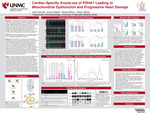
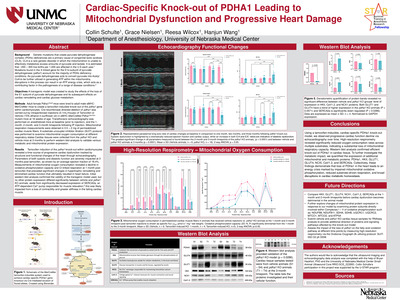
Cardiac-Specific Knock-out of PDHA1 Leading to Mitochondrial Dysfunction and Progressive Heart Damage
Collin T. Schulte, Grace K. Nielson, Reesa M. Wilcox, and Han-Jun Wang
Background Genetic mutations that create pyruvate dehydrogenase complex (PDHc) deficiencies are a primary cause of congenital lactic acidosis (CLA). CLA is a rare genetic disorder in which the mitochondrion is unable to effectively metabolize excess amounts of pyruvate and lactate. It is estimated that ~250 – 300 live births per 1,000 are affected in the U.S each year. Mutations found in the X-linked gene for the E1α subunit of pyruvate dehydrogenase (pdha1) account for the majority of PDHc deficiency conditions. As pyruvate dehydrogenase acts to convert pyruvate into Acetyl CoA to be further utilized in generating ATP within the mitochondria, disruptions in this process can result in an ATP energy crisis, which acts as a contributing factor in the pathogenesis of a range of disease conditions.
Objectives A transgenic model was created to study the effects of the loss of the E1 subunit of pyruvate dehydrogenase and its subsequent effects on cardiac remodeling and cardiac glucose metabolism.
Methods Adult female Pdha1flox8 mice were bred to adult male αMHC-MerCreMer mice to create a tamoxifen-inducible knock-out of the pdha1 gene within cardiomyocytes. Cre-recombinase directed deletion of pdha1 was carried out by intraperitoneal injections (0.1mL/mouse) of Tamoxifen or Vehicle (15% ethanol in sunflower oil) in αMHC-MerCreMer:Pdha1flox/flox mutant mice at 16 weeks of age. Transthoracic echocardiography was performed on anesthetized mice at baseline (prior to injection), and the 1-month, 2-month, and 3-month timepoints following IP injection. Mitochondrial respiration measurements were obtained in 0.5 – 2 mg of permeabilized cardiac muscle fibers. A substrate-uncoupler-inhibitor titration (SUIT) protocol was performed to examine mitochondrial oxygen consumption at different respiratory states Cardiac tissues were collected from the pdha1 KO and vehicle mice at 3 months to perform western blot analysis to validate various metabolic and mitochondrial protein expression.
Results Tamoxifen induction of the pdha1 knock-out within cardiomyocytes revealed a time course of progressive cardiac dysfunction tracked by structural and functional changes of the heart through echocardiography. Parameters of both systolic and diastolic function are severely impacted at 3 months post tamoxifen, as shown by an average ejection fraction of 18.4%. Measurements of mitochondrial oxygen consumption revealed a decline in oxidative phosphorylation capacity and CI-linked respiration at 1 month post tamoxifen that preceded significant changes in hypertrophic remodeling and diminished cardiac function that ultimately resulted in heart failure. Initial western blot analysis confirmed the validity of the transgenic model used, but no other protein expression differed significantly between vehicle and pdha1 KO animals, aside from significantly decreased expression of SERCA2a, an ATP-dependent Ca2+ pump responsible for muscle relaxation; this was likely impacted from a loss of contractility and greater stiffness in the failing cardiac muscle.
-
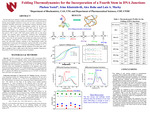
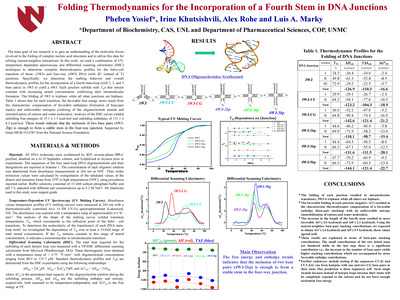
Folding Thermodynamics for the Incorporation of a Fourth Stem in DNA Junctions
Pheben Yosief, Irine Khutsishvili, Alex Rohe, and Luis A. Marky
The main goal of our research is to gain an understanding of the molecular forces involved in the folding of complex nucleic acid structures and to utilize this data for refining nearest-neighbor interactions. In this work, we used a combination of UV-temperature dependent spectroscopy and differential scanning calorimetry (DSC) techniques to determine complete thermodynamic profiles for the helix-coil transition of three- (3WJ) and four-way (4WJ) DNA (with dU instead of T) junctions. Specifically, we determine the melting behavior and overall thermodynamic profiles for the incorporation of a fourth stem-loop (with 2, 3, and 5 base pairs) in 3WJ to yield a 4WJ. Each junction unfolds with TMs that remain constant with increasing strand concentration, confirming their intramolecular formation. The folding of 3WJ is triphasic while all other junctions are biphasic. Table 1 shows that for each transition, the favorable free energy terms result from the characteristic compensation of favorable enthalpies (formation of base-pair stacks) and unfavorable entropies (ordering of the oligonucleotide strands and immobilization of cations and water molecules). Analysis of the DSC curves yielded unfolding free energies of 19.1 ± 1.5 kcal/mol and unfolding enthalpies of 131.1 ± 8.3 kcal/mol. These trends indicate that the inclusion of two base pairs (4WJ-2bp) is enough to form a stable stem in the four-way junction. Supported by Grant MCB-1912587 from the National Science Foundation.
Printing is not supported at the primary Gallery Thumbnail page. Please first navigate to a specific Image before printing.