

Files
Download Full Text (2.9 MB)
Presentation date
Summer 8-6-2026
College, Institute, or Department
Child Health Research Institute / Pediatrics
Faculty Mentor
Jeffrey Salomon
Research Mentor
Jeffrey Salomon
Abstract
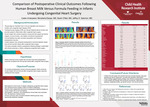
Infants with congenital heart disease undergoing cardiopulmonary bypass often develop intestinal barrier dysfunction, microbial dysbiosis, and systemic inflammation that may impair postoperative recovery. This retrospective cohort study compared postoperative outcomes between infants receiving human breast milk (n = 15) and formula (n = 15) after congenital heart surgery. Clinical, microbiome, inflammatory, and gut barrier data were analyzed. Infants fed human breast milk demonstrated greater bacterial diversity, reduced gut barrier dysfunction and inflammation, shorter intensive care unit and hospital lengths of stay, and lower vasoactive-inotropic scores compared with formula-fed infants. These findings suggest that human breast milk may improve postoperative recovery and support the role of nutrition in optimizing outcomes following congenital heart surgery.
Rights
The author holds the copyright to this work and any reuse or permissions must be obtained from the author directly.
Keywords
Congenital heart disease, human breast milk, formula feeding, infant nutrition, cardiopulmonary bypass, gut microbiome, intestinal barrier dysfunction, postoperative outcomes, inflammation, pediatric cardiac surgery.
Recommended Citation
Anderjaska, Caden; Elango, Monalisha; O'Neil, Sarah; and Salomon, Jeffrey D., "Comparison of Postoperative Clinical Outcomes Following Human Breast Milk Versus Formula Feeding in Infants Undergoing Congenital Heart Surgery" (2026). Posters: 2026 Summer Undergraduate Research Program. 7.
https://digitalcommons.unmc.edu/surp2026/7