

Files
Download Full Text (1.8 MB)
Presentation date
2026
College, Institute, or Department
Surgery
Faculty Mentor
Arika Hoffman
Research Mentor
Arika Hoffman, Charlotte Hunt
Abstract
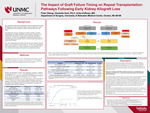
Early kidney graft failure may limit access to repeat transplantation, yet little is known about how graft failure timing affects progression through the repeat transplantation pathway. This study compared outcomes among deceased donor kidney transplant recipients with primary non-function (PNF; < 90 days) and early graft failure (EGF; 90–365 days) and evaluated factors associated with access to repeat transplantation. A retrospective cohort study of deceased donor kidney transplant recipients with graft failure within one year (N=32; PNF, n=23; EGF, n=9) was conducted using data from 2016–2026. Re-evaluation, relisting, and retransplantation were analyzed, with chart review used to identify reasons for pathway drop-off. Patients with PNF were more likely to undergo re-evaluation (60.9% vs. 11.1%; p=0.018) and relisting (69.6% vs. 11.1%; p=0.005; OR 18.3). Cox regression demonstrated a lower likelihood of relisting among patients with graft failure between 90 and 365 days (HR 0.13, 95% CI 0.02–0.97; p=0.047). Retransplantation occurred more frequently following PNF (43.5% vs. 11.1%; p=0.115).
Rights
The author holds the copyright to this work and any reuse or permissions must be obtained from the author directly.
Keywords
kidney transplantation, graft failure, retransplantation, transplant access, racial disparities, relisting, re-evaluation, OPTN Policy 3.6.B
Recommended Citation
Obang, Peter; Hunt, Charlotte; and Hoffman, Arika L., "The Impact of Graft Failure Timing on Repeat Transplantation: Pathways Following Early Kidney Allograft Loss" (2026). Posters: 2026 Summer Undergraduate Research Program. 9.
https://digitalcommons.unmc.edu/surp2026/9