

Files
Download Full Text (669 KB)
Presentation date
2025
College, Institute, or Department
Pharmaceutical Sciences
Faculty Mentor
Luis A. Marky
Research Mentor
Luis A. Marky
Abstract
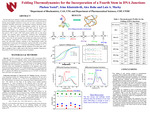
The main goal of our research is to gain an understanding of the molecular forces involved in the folding of complex nucleic acid structures and to utilize this data for refining nearest-neighbor interactions. In this work, we used a combination of UV-temperature dependent spectroscopy and differential scanning calorimetry (DSC) techniques to determine complete thermodynamic profiles for the helix-coil transition of three- (3WJ) and four-way (4WJ) DNA (with dU instead of T) junctions. Specifically, we determine the melting behavior and overall thermodynamic profiles for the incorporation of a fourth stem-loop (with 2, 3, and 5 base pairs) in 3WJ to yield a 4WJ. Each junction unfolds with TMs that remain constant with increasing strand concentration, confirming their intramolecular formation. The folding of 3WJ is triphasic while all other junctions are biphasic. Table 1 shows that for each transition, the favorable free energy terms result from the characteristic compensation of favorable enthalpies (formation of base-pair stacks) and unfavorable entropies (ordering of the oligonucleotide strands and immobilization of cations and water molecules). Analysis of the DSC curves yielded unfolding free energies of 19.1 ± 1.5 kcal/mol and unfolding enthalpies of 131.1 ± 8.3 kcal/mol. These trends indicate that the inclusion of two base pairs (4WJ-2bp) is enough to form a stable stem in the four-way junction. Supported by Grant MCB-1912587 from the National Science Foundation.
Keywords
DNA Junctions, Thermodynamics, Fourth Stem
Recommended Citation
Yosief, Pheben; Khutsishvili, Irine; Rohe, Alex; and Marky, Luis A., "Folding Thermodynamics for the Incorporation of a Fourth Stem in DNA Junctions" (2025). Posters: 2025 Summer Undergraduate Research Program. 1.
https://digitalcommons.unmc.edu/surp2025/1