

Files
Download Full Text (1.8 MB)
Presentation date
2025
College, Institute, or Department
Child Health Research Institute / Pediatrics
Faculty Mentor
Sidharth Mahapatra
Research Mentor
Sidharth Mahapatra, Maria Burkovetskaya
Abstract
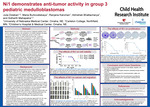
Medulloblastoma is one of the most common malignant pediatric brain tumors, typically arising in the cerebellum of children between the ages of 3 and 8 years. Of the four subgroups, group 3 is the most aggressive, with a < 50% 10-year overall survival rate. In group 3 medulloblastoma, alterations to chromosome 17 can result in an isochromosome (i17q) and haploinsufficiency of the 17p13.3 region. This locus houses miR-1253, a tumor suppressor gene that regulates CD276 (B7-H3), an immunomodulatory protein implicated in cancer aggressiveness. Silencing miR-1253 can trigger overexpression of B7-H3, leading to immune suppression and increased tumor growth. In this study, we investigated a small molecule inhibitor of B7-H3, B7-H3-Ni1 (Ni1). Group 3 MB cancer cells (HDMB03) were treated with varying concentrations of Ni1. The effects of Ni1 on viability, proliferation, and stemness were assessed using MTT ( 3-(4,5-dimethylthiazol-2-yl)-2,5-diphenyltetrazolium bromide), wound healing (scratch), and colony formation assays, respectively. Ni1 induced a dose-dependent reduction in proliferation and viability, alongside a significant impairment in cellular migratory ability. These findings suggest that Ni1 affects key oncogenic behaviors in group 3 medulloblastoma cells, warranting further investigation as a potential targeted therapeutic.
Keywords
B7-H3, miR-1253, Group 3 pediatric medulloblastoma
Recommended Citation
Dziekan, Julia; Burkovetskaya, Maria; Kanchan, Ranjana; Bhattacharya, Abhishek; and Mahapatra, Sidharth, "Ni1 Demonstrates Anti-Tumor Activity in Group 3 Pediatric Medulloblastomas" (2025). Posters: 2025 Summer Undergraduate Research Program. 9.
https://digitalcommons.unmc.edu/surp2025/9