

Files
Download Full Text (1.9 MB)
Presentation date
8-2025
College, Institute, or Department
Anesthesiology
Faculty Mentor
Georgette D. Kanmogne
Research Mentor
Biju Bhargavan, Georgette D. Kanmogne
Abstract
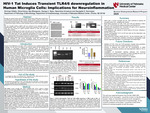
Microglia, the resident immune cells of the central nervous system (CNS), plays a pivotal role in neuroinflammation associated with HIV infection. Toll-like receptors (TLRs) are critical innate immune sensors expressed in microglia, and their dysregulation is implicated in HIV-associated neurocognitive disorders (HAND). In this preliminary study, we examined the basal expression of TLRs and the impact of HIV-Tat on their expression using the human microglial HMC3 cell line.
First, the microglial identity of HMC3 cells was confirmed by the expression of Iba1, a microglia-specific marker. RT-PCR analysis revealed basal expression of TLR2, TLR4, andTLR6, with TLR4 showing the highest expression followed by TLR6 and TLR2 under unstimulated conditions.
Treatment with recombinant HIV-Tat protein (50 ng/mL) for 24 hours resulted in a significant downregulation of TLR4 mRNA levels, with a rebound at 48 hours. Upon treatment with HIV-Tat protein, TLR6 mRNA levels were also significantly downregulated at 24 hours, with a partial recovery observed by 48 hours. Heat-inactivated Tat (HI-Tat) served as a negative control and did not significantly affect TLR expression compared to untreated controls.
These initial findings suggest that HIV-Tat selectively alters TLR expression in microglial cells, potentially contributing to CNS immune dysregulation during HIV infection. Further investigations involving a broader range of Tat concentrations and time points are necessary to validate and expand upon these observations.
Keywords
Microglia, Cells, HIV, TAT protein, Toll like receptors
Recommended Citation
Gillella, Shrimayi; Antony, Olivia; Bhargavan, Biju; Njoku, George C.; Annadurai, Narendran; and Kanmogne, Georgette D., "HIV-1 Tat Induces Transient TLR4/6 downregulation in Human Microglia Cells: Implications for Neuroinflammation" (2025). Posters: 2025 Summer Undergraduate Research Program. 6.
https://digitalcommons.unmc.edu/surp2025/6