

Files
Download Full Text (4.5 MB)
Presentation date
Summer 8-8-2025
College, Institute, or Department
Pathology, Microbiology, and Immunology
Faculty Mentor
Rakesh K. Singh
Research Mentor
Ridhi Bhola
Abstract
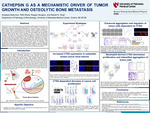
Breast cancer is one of the leading causes of cancer-related mortality, largely due to its tendency to metastasize to bone. Our lab has demonstrated that tumor-bone interaction is important in this osteolytic bone metastasis mediated by the dysregulation of a unique set of genes. Among these genes, several proteases are up-regulated at the tumor-bone interface, including Cathepsin G, a serine protease, which is primarily secreted by neutrophils. These proteases act as mediators between the tumor and the stroma. Previously, we have shown that malignant cells and osteoclasts at the TB interface express higher levels of Cathepsin G, which is critical for osteolytic bone metastasis. The precise role of tumor and host-derived Cathepsin G in osteolytic bone metastasis is unknown. This study aims to investigate the functional significance of both tumor-derived and neutrophil-derived CTSG in regulating breast cancer cell proliferation, aggregation, and migration. We used recombinant CTSG protein, CTSG overexpression in tumor cells, and direct co-culture with primary neutrophils (MPRO) to evaluate its effects on CI66 murine breast cancer cells. Overall, our findings show that CTSG significantly suppresses breast cancer cell proliferation, while paradoxically enhancing tumor cell aggregation and collective migration. Live-cell imaging and migration assays indicate a shift toward cohesive, cluster-based motility associated with metastatic potential. Both neutrophil-derived and tumor-intrinsic CTSG contribute to this dual phenotype, highlighting CTSG as a potential therapeutic target to interrupt early metastatic progression.
Keywords
Cathepsin G, Breast Cancer, Bone metastasis
Recommended Citation
Nedunoori, Srilaasya; Bhola, Ridhi; Sturgeon, Reegan; and Singh, Rakesh K., "Cathepsin G as a Mechanistic Driver of Tumor Growth and Osteolytic Bone Metastasis" (2025). Posters: 2025 Summer Undergraduate Research Program. 8.
https://digitalcommons.unmc.edu/surp2025/8