

Peer-Review and Editorial Process
Manuscript Submission and Tracking
Preliminary Check
Peer-Review Process
Manuscript Revision
Editorial Decision
Proofreading
Production
Publishing Standards and Report Guidelines
Post-Production Discussion and Corrections
Author Appeal
Ethical Standards
Editorial Independence
Contact Information
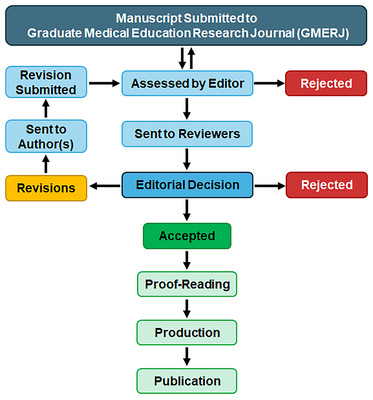
Manuscript Submission and Tracking
- Each submitted manuscript to the GMERJ is assigned a manuscript number (MS#). Authors can track the progress of their submission through the journal's online submission system
- Authors are encouraged to log in periodically to monitor updates throughout the review and editorial process.
Preliminary Check
- GMERJ will not consider manuscripts that are simultaneously being considered by other journals, or that are redundant or duplicate in nature.
- All manuscripts undergo an initial review by the GMERJ Editorial Office to ensure compliance with author guidelines, journal scope, and ethical policies. This includes evaluation of quality, clarity, novelty, adherence to reporting standards, and ethical compliance. Manuscripts failing to meet these criteria are returned for revision prior to peer review.
- The corresponding author is responsible for ensuring the manuscript’s accuracy and must provide final approval on behalf of all co-authors, either after consultation or under prior authorization.
- All submitted manuscripts are screened with Turnitin anti-plagiarism software before proceeding to editorial review.
- The Editor-in-Chief and Associate Editor evaluate each submission, recommend peer review, may request pre-review revisions, or reject the manuscript at the preliminary stage. In cases of conflict of interest or delegation by the Editor-in-Chief, an Editorial Board Member will handle the evaluation and reviewer selection.
- Editors and Editorial Board Members are prohibited from handling their own submissions. Such manuscripts are processed independently by alternative editors with no conflicts of interest.
Peer-Review Process
- GMERJ adopts a single-blind peer review process conducted by independent peer reviewers with expertise relevant to the subject matter.
- Reviewers assess manuscripts based on their relevance, originality, methodology, clarity, ethical soundness, and contribution to the field.
- Based on reviewers’ reports, one of the following initial decisions is recommended:
- Accept submission on the current form
- Accept submission with minor revisions
- Minor revisions required for acceptance
- Major revisions required for acceptance
- Reject submission
Manuscript Revision
- Authors receive editorial decisions and reviewer feedback via the online submission system.
- When minor or major revisions are recommended, the authors are requested to revise their manuscript accordingly before it is referred to the Editor-in-Chief.
- Minor revisions may not require re-review by the reviewers, unless specifically requested by the reviewer to see the revised version.
- Major revisions will typically be re-evaluated by the original reviewers. Generally, no more than two rounds of major revision will be permitted per manuscript. Any additional revisions will be at the discretion of the Editor-in-Chief.
- Authors must provide point-by-point responses to reviewer comments. If the authors disagree with a reviewer’s suggestion, they should include a clear and respectful explanation or rebuttal.
Editorial Decision
- Following peer review, the Editor-in-Chief makes final publication decisions, taking into account the evaluations and recommendations of the reviewers and the Associate Editor.
- Authors are notified of the editorial decisions and provided detailed feedback via the online submission system.
- Appeals regarding editorial decisions must be submitted to the Editorial Board with a clear explanation and supporting information.
- Final editorial decisions after revision may include:
- Accept in the current revised form
- Required minor revision
- Require major revision
- Reject
Proofreading
- The corresponding author will receive an email notification when the proofread files are ready for review.
- Authors are required to carefully review proofs and return corrections promptly to avoid delays in publication.
- If the corresponding author is unavailable for an extended period, they must provide alternate contact details for a co-author or representative who can review and approve the proofs.
Publication
- Following final approval, articles will be published in both online and print formats. The online version is available as a downloadable PDF.
- The articles may be uploaded to an intermittent issue before the final issue is updated and closed.
- Once an article is published on the web, authors do not have the right to make any changes to their article.
Disclaimers
- Published content reflects the views of the author(s) and does not represent the views of the journal or publisher.
- GMERJ supports editorial independence, allowing editors to make publication decisions.
Publishing Standards and Reporting Guidelines
- Submission of a manuscript to GMERJ indicates that all authors have read, understood, and agreed to the content of the submission and that it complies with the journal's ethical and editorial policies.
- For detailed information, please refer to the journal guidelines available on the GMERJ website.
Post-Publication Discussions and Corrections
- GMERJ follows the Committee on Publication Ethics (COPE) post-publication discussion and corrections guidelines to preserve the integrity of the scholarly record.
- Minor errors that do not alter an article’s conclusions may be corrected at the Editor's discretion, with changes indexed and linked to the original article.
- Major errors or breaches of integrity that make results unreliable lead to retraction. Retraction notices explain the reasons, link to the original article, and notify authors (whose approval is not required). Retracted articles are clearly marked, and APCs are not refunded. Decisions may only be reconsidered if new evidence arises.
- Articles may be removed only in exceptional cases, such as defamation, legal violations, or public safety risks, or when required by court or government order.
- GMERJ supports scholarly discussion through post-publication comments, including challenges or clarifications. Comments may be peer reviewed and published online, with original authors invited to respond.
- For detailed guidance, please refer to the journal Editorial Policies and COPE Best Practice Guidelines .
Author Appeal
- GMERJ follows COPE guidelines for handling complaints and appeals.
- Authors can appeal a rejection only if they believe the decision did not follow the journal's policies or procedures and must provide a detailed point-by-point response.
- The Editor-in-Chief will review the case to ensure fairness, but if proper procedures were followed, the decision is final.
- For detailed guidance, please refer to the journal Editorial Policies and COPE Best Practice Guidelines .
Ethical Standards
- GMERJ adheres to the ethical principles outlined by the COPE and the International Committee of Medical Journal Editors (ICMJE) recommendations for the conduct, reporting, editing, and publication of scholarly work in medical journals.
- GMERJ is committed to maintaining integrity and transparency in the publication process. The journal follows COPE's established procedures for handling potential ethical concerns or misconduct by authors, reviewers, or editors.
- All editorial staff are trained to recognize, evaluate, and respond appropriately to ethical issues such as plagiarism, data fabrication, falsification, redundant publication, and authorship disputes.
- For detailed guidance, please refer to the journal's Editorial Policies and COPE Best Practice Guidelines .
Editorial Independence
GMERJ's editorial policy aligns with the principles of editorial independence as articulated by the World Association of Medical Editors (WAME).
- GMERJ upholds the principle of editorial independence, ensuring that editorial decisions are made solely based on the scholarly merit, scientific quality, and relevance of the submission—free from external influence or conflict of interest.
- Editors are not subject to pressure or interference from the journal's publisher, sponsors, or affiliated institutions.
- All editorial judgments—including decisions to accept, revise, or reject manuscripts—are made independently in alignment with the journal's ethical and editorial standards.
Contact Information
- Complaints or appeals should be submitted in writing to the Journal Editorial Office via the official contact email listed on the GMERJ website.
- All correspondence should clearly identify the manuscript in question and provide relevant supporting documentation.
